

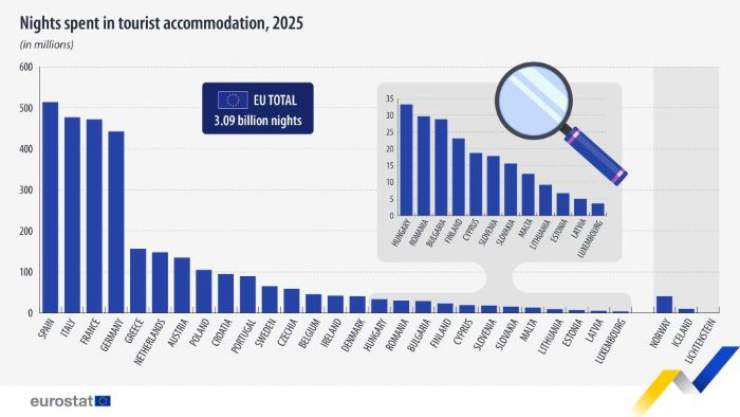
2025 was another record-setting year for EU tourism, with nearly 3.1 billion nights spent in tourist accommodation establishments across the EU. This reflects a 2.2 percent increase, or 66.4 million more nights than in 2024.
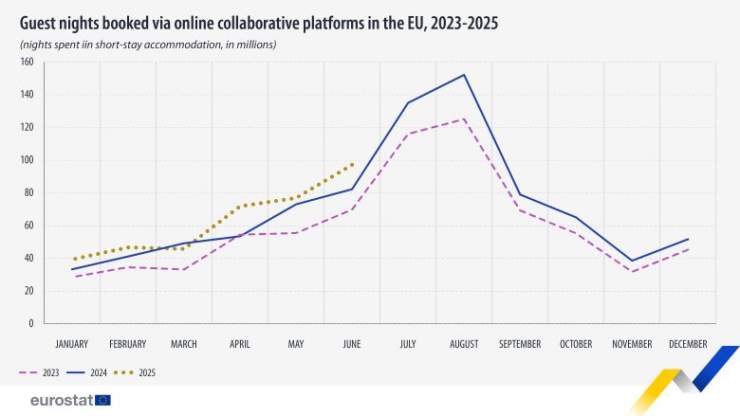
In the second quarter of this year, guests spent 245.9 million nights in short-term rental accommodation in the EU, booked via Airbnb, Booking or Expedia.
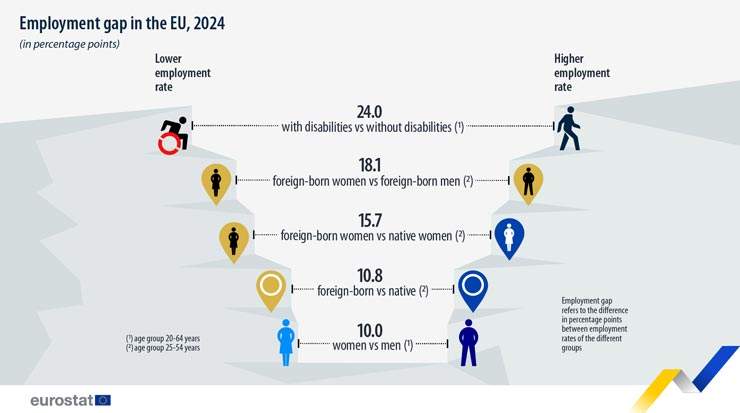
In 2024, employment inequalities linked to disability, gender and origin were recorded in the EU. The gender employment gap in the EU was 10.0 percentage points (pp), with an employment rate of 80.8% for men and 70.8 percent for women. The gap was 0.2 pp lower than in 2023 and 1.1 pp lower compared with 2014.

In 2021, 11.3 million people in the EU were employed in economic activities related to tourism (but not necessarily relying only on tourism).

In 2022, overall life satisfaction in the EU averaged 7.1, based on a scale from 0 (not satisfied at all) to 10 (fully satisfied). The score was slightly down compared with 7.3 in 2018 and consistent with 7.0 in 2013.
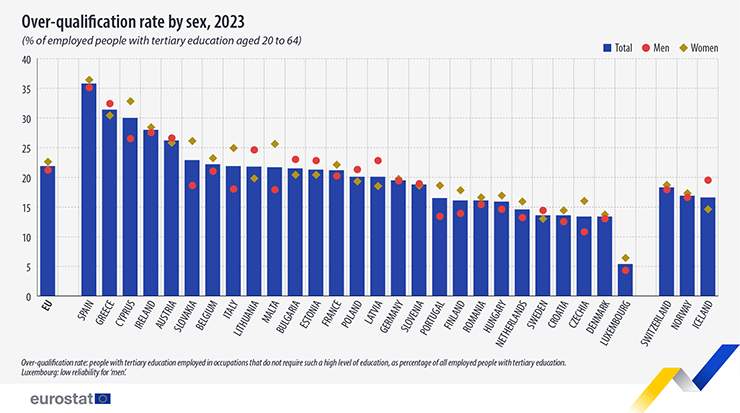
In 2023, more than 75 percent (195.7 million) of the EU’s 20 to 64-year-olds were employed, the highest share recorded since the start of the time series in 2009. This marks three consecutive years of growth after a drop to 72 percent in 2020 due to the COVID-19 pandemic.

During 2023, guests spent 678.6 million nights in short-term rental accommodation in the EU booked via Airbnb, Booking, Expedia Group or TripAdvisor. This corresponds to a 13.8 percent increase compared with 2022 (596.5 million).

In 2023, 56 percent of people in the EU aged 16 to 74 had at least basic overall digital skills.

In 2022, at the EU level, 34 percent of all tourism nights spent occurred in just two months, July and August. In nearly three of four EU regions at level two of the nomenclature of territorial units for statistics (NUTS 2), August was the month with the highest concentration in the number of nights spent (170 out of the 242 EU NUTS two regions). It was followed by July in 62 EU regions, covering most of Northern Europe and parts of Belgium, Czechia, Germany, France, Italy, Hungary and Slovakia.
- Most Read