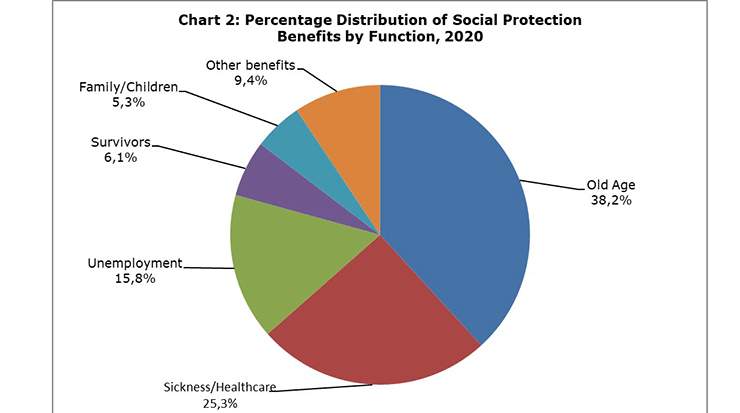

The most significant functions were those of old age and sickness/healthcare, which combined, constituted 63,5 percent of the social protection benefits for 2020 (compared to 71,1 percent in 2019).
The largest share of old age benefits (which comprise both cash benefits, i.e., periodic pensions and benefits, and lump sum benefits, as well as old age benefits in kind like housing, provision of assistance in carrying out daily tasks and other benefits in kind), concerns periodic pensions which amounted to EUR1.793,5 million and which constituted 90,5 percent of the total old age benefits. It is worth noting, that the EUR1.702,6 million of the periodic pensions that were granted to beneficiaries in 2020, were non-means tested, i.e., without verification of the recipients’ financial situation.
There was an increase in the social benefits of the function of unemployment in 2020, which amounted to EUR818,7 million (compared to EUR202,2 million in 2019), the function of old age which amounted to EUR1.980,9 million (compared to EUR1.869,1 million in 2019), the function of sickness/healthcare with the social benefits amounting to EUR1.310,9 million in 2020 (compared to EUR1.028,8 million in 2019), the function of survivors which amounted to EUR314,2 million in 2020 (compared to EUR298,0 million in 2019), the function of family with EUR273,5 million in 2020 (compared to EUR236,9 million in 2019), the function of social exclusion with EUR243,6 million in 2020 (compared to EUR203,2 million in 2019) and the function of housing which also had a small increase in 2020 with social benefits which amounted to EUR79,7 million (compared to EUR73,8 million in 2019). On the contrary, a small decrease in social benefits was recorded in the function of disability in 2020, which amounted to EUR162,8 million (compared to EUR165,0 million in 2019).
Most of the social protection benefits that were provided to beneficiaries in 2020 (88,5 percent), were non-means tested benefits. Specifically, this accounts for EUR4.589,3 million in 2020. In most cases, the beneficiaries, having made cash contributions to various insurance funds (e.g., the Social Insurance Fund), gain the right to benefits, without their income being a criterion. In other words, most social protection benefits are not explicitly or implicitly conditional on the beneficiary’s income and/or wealth falling below a specified level. Furthermore, most of the benefits in 2020 were cash benefits (EUR3.818,2 million), whereas benefits in kind constituted only 26,3 percent of the total of social protection benefits (EUR1.366,1 million). As regards cash benefits, 84,6 percent (EUR3.231,7 million) were provided periodically, for example pensions and other benefits, whereas lump sum benefits constituted 15,4 percent of the cash benefits.
The Social Insurance Scheme is the largest provider of social benefits in Cyprus with benefits of EUR1.643,4 million in 2020, representing a share of 31,1 percent of the total expenditure. The contribution of the scheme of Other Governmental Social Protection is also significant, with EUR1.315,9 million which represents a share of 24,9 percent of the total expenditure. Then follows the General Healthcare System (GHS) with EUR657,0 million and a share of 12,4 percent the scheme of the Central Government Health Services with EUR526,6 million and a share of 10 percent the Civil Service Social Protection with EUR496,0 million and a share of 9,4 percent and the semi-autonomous Social Insurance Institutions with EUR362,3 million and a share of 6,9 percent. Smaller rates were recorded in the remaining schemes.