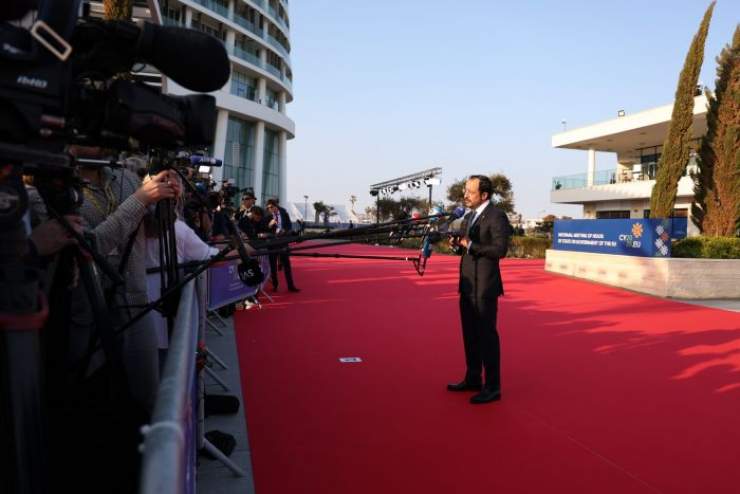

"We are particularly proud of the fact that we are hosting the first European Council since the accession of the Republic of Cyprus to the European Union (EU) in 2004. With the same pride, we also exercise the role of the Presidency of the Council of the EU.
During these two days, the topics for discussion come to confirm the priorities of our Presidency. The first is the strengthening of our relations with neighbouring states. Tomorrow, a very important summit will be held with the leaders of the region, not only to exchange views on the situation in the region, but much more – after the announcement of the Mediterranean package – how, through concrete actions, we upgrade our relations with the states of the region, to a strategy.
The second concerns the EU’s strategic autonomy. The EU’s strategic autonomy has two main components. One is the energy issues that we will discuss tonight: as immediate solutions, the Commission’s package of proposals, but also in the long term [how] to achieve the goal of the energy union, a key goal of the Cyprus Presidency as well.
Second, the issues of defence and security. In particular, to give substance, to give an operational plan in the event that a Member State decides to activate Article 42(7) of the EU Treaty. Now is the time, taking into account also regional and international developments, to give substance through concrete actions to our common goal of achieving the EU’s strategic autonomy.”
Asked to state what the implementation of Article 42(7) means, Christodoulides said, “We have specific proposals and I am sure that there are specific proposals from the Commission, as well as from other Member States, [regarding] what happens when a state activates this particular article. For example, the region where the specific state is located should be taken into account, which states can help immediately, what kind of assistance is needed – because assistance is directly dependent on the capabilities of the state, but also the threats it receives – and so on. So we have a specific plan, which we will present tonight. We will listen to the views of all our partners in the EU, so that an operational map can be defined.”
Asked whether decisions will be taken to address the high cost of energy, Christodoulides commented: “Yes. Today the President of the [European] Commission has announced some specific proposals, which we will discuss tonight. These are the immediate measures that need to be taken. At the same time, we should also look at how we become energy autonomous in the long term. In order to achieve energy autonomy, we need to achieve the goal of the energy union. So there are two parts: The immediate measures, which we will discuss tonight and concern energy costs, due to developments in the region, and the long-term ones that concern achieving the goal of the energy union.”
Asked about yesterday's statement by the European Commissioner for Enlargement, Marta Kos, on the opening of the chapter group of Ukraine's accession negotiations - following the results of the elections in Hungary - President Christodoulides stated that as the Presidency of the Council of the EU, we have completed all the preparatory work and, provided that the political conditions are in place, we are ready to open the chapter group.
Commenting on the war in Iran, the President of the Republic of Cyprus stated that de-escalation cannot be achieved without the active participation of the EU.