
Field work is carried out in the context of the “Palaepaphos Urban Landscape Project” (PULP), directed since 2006 by professor Maria Iacovou of the Archaeological Research Unit. This year, the project began in May with a geophysical survey of the mound professorr A. Sarris (Digital Humanities GeoInformatics Laboratory, UC) in collaboration with the Geophysical-Remote Sensing & Archaeoenvironment Lab (Institute for Mediterranean Studies, Foundation for Research & Technology Hellas).
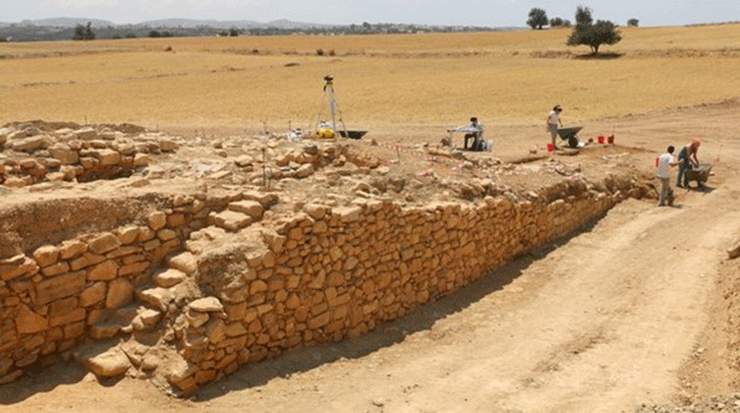
It continued with targeted excavations on the north side of the mound directed by professor Jacopo Tabolli (University of Siena - UNISTRASI) (FIG.4), and it was completed with a new UAV survey of the excavated monuments by Dr Kyriakos Themistokleous and Dr Athos Agapiou (Remote Sensing & Geo-Environment Lab, Cyprus University of Technology).
Tumuli of monumental dimensions, like for example the grand Macedonian tumuli, were until recently almost unknown in Cyprus. In 2011, the hillock of Laona, one km to the NE of the sanctuary of Aphrodite in Palaepaphos-Kouklia, was identified as an artificial mound. Its dimensions are considerably greater than those of the Salamis tumulus raised over the so-called “cenotaph of Nikokreon”.
Over the last decade, the mound became the subject of specialised studies by PULP; it is gradually being excavated and documented digitally. The first unexpected discovery that surprised the archaeological team was the revelation of an earlier monument, a Cypro-Classical rampart, on top of which the mound was erected, most probably at the end of the 4th c. or early in the 3rd c. BC.