

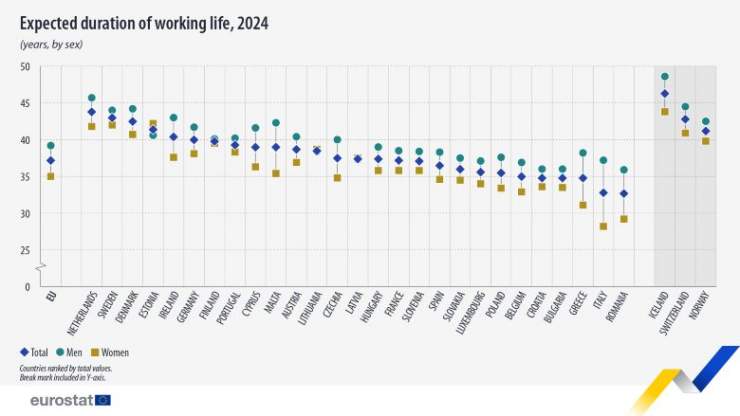
In 2024, the expected average duration of working life for 15-year-olds and over in the EU was 37.2 years. However, the expected average duration of working life varied broadly among EU countries.
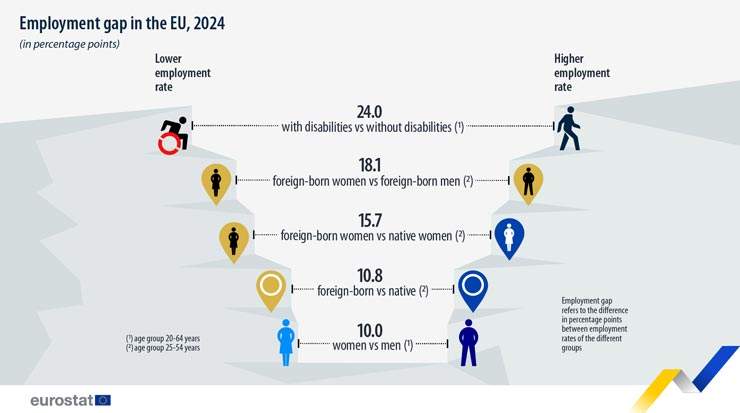
In 2024, employment inequalities linked to disability, gender and origin were recorded in the EU. The gender employment gap in the EU was 10.0 percentage points (pp), with an employment rate of 80.8% for men and 70.8 percent for women. The gap was 0.2 pp lower than in 2023 and 1.1 pp lower compared with 2014.

In 2024, guests spent 854.1 million nights in short-term rental accommodation in the EU, booked via Airbnb, Booking, Expedia Group or TripAdvisor. This represents an 18.8 percent increase compared with 2023 (719.0 million nights), setting a new record high.

As spring starts, trade of flower bulbs blossoms. Warmer temperatures and longer days bring renewed interest from florists, retailers and consumers, fuelling the export market.

In 2023, the unemployment rate for 15-74 years old in the EU fell to 6.1 percent of the labour force, the lowest level since 2014.

During the second quarter of this year, guests spent 208.8 million nights in short-term rental accommodation in the EU, booked via Airbnb, Booking, Expedia Group or TripAdvisor. This corresponds to an increase of 16.2 percent compared with the same period in 2023.

During the first quarter of this year, guests spent 123.7 million nights in short-term rental accommodation in the EU, booked via Airbnb, Booking, Expedia Group or TripAdvisor. This corresponds to an increase of 28.3 percent compared with the same period in 2023.

In 2021, 1.5 million enterprises in the EU had their core business in the real estate sector, representing 4.8 percent of all active enterprises in the EU’s business economy. This marked an 11 percent increase from 2020 (1.3 million enterprises).

In 2022, EU countries produced 4.8 million pairs of skis and snowboards, an increase of 37 percent when compared with 2021. Almost half of these items (2.2 million; 45 percent) were produced in Austria.

In 2023, 56 percent of people in the EU aged 16 to 74 had at least basic overall digital skills.
- Most Read