


Cyprus supports and endorses the Roadmap for Women’s Rights, announced by the European Commission on this year’s International Women’s Day.
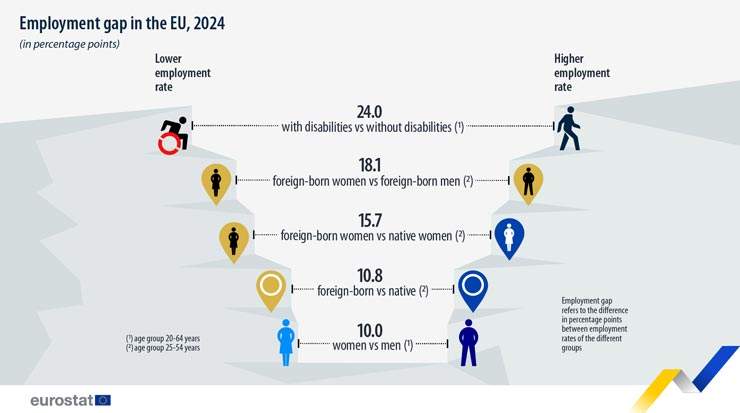
In 2024, employment inequalities linked to disability, gender and origin were recorded in the EU. The gender employment gap in the EU was 10.0 percentage points (pp), with an employment rate of 80.8% for men and 70.8 percent for women. The gap was 0.2 pp lower than in 2023 and 1.1 pp lower compared with 2014.

In 2024, guests spent 854.1 million nights in short-term rental accommodation in the EU, booked via Airbnb, Booking, Expedia Group or TripAdvisor. This represents an 18.8 percent increase compared with 2023 (719.0 million nights), setting a new record high.

As spring starts, trade of flower bulbs blossoms. Warmer temperatures and longer days bring renewed interest from florists, retailers and consumers, fuelling the export market.

In 2023, the unemployment rate for 15-74 years old in the EU fell to 6.1 percent of the labour force, the lowest level since 2014.

After a record year with more than 22.000 participants, the European Statistics Competition will be held for the eighth consecutive time, by the European Statistical System (ESS), consisting of the Statistical Offices of the Member States of the European Union and the European Statistical Service (Eurostat).

During the second quarter of this year, guests spent 208.8 million nights in short-term rental accommodation in the EU, booked via Airbnb, Booking, Expedia Group or TripAdvisor. This corresponds to an increase of 16.2 percent compared with the same period in 2023.

In July of this year, the consumer price of package holidays in the EU was 6.6 percent higher than in July 2023. The price of domestic holiday packages was up 11.1 percent, while international holiday packages saw a 5.7 percent increase.

During the first quarter of this year, guests spent 123.7 million nights in short-term rental accommodation in the EU, booked via Airbnb, Booking, Expedia Group or TripAdvisor. This corresponds to an increase of 28.3 percent compared with the same period in 2023.
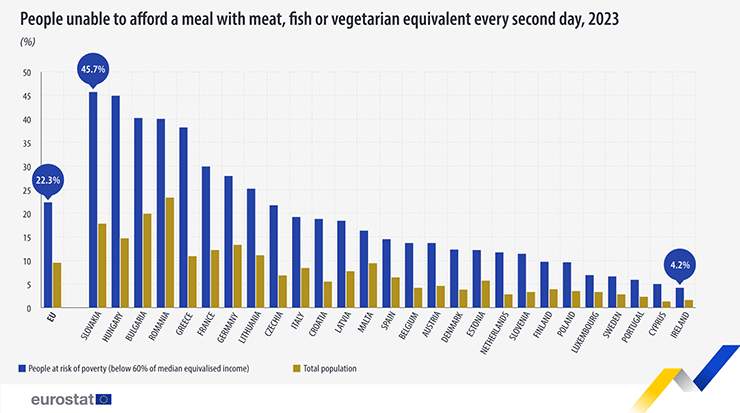
In 2023, 9.5 percent of the EU population were unable to afford a meal containing meat, fish or a vegetarian equivalent every second day, 1.2 percentage points (pp) higher compared with 2022 (8.3 percent).
- Most Read